
Post-Luxury Status Symbol #4: Hyper-Niche Expertise
Why the coolest person you know right now has a strangely specific hobby

Every one of us is like a man who sees things in a dream and thinks that he knows them perfectly and then wakes up to find that he knows nothing. - Plato, Statesman
I’m not an AI-luddite, nor am I nostalgic for the world that preceded it. But it does increasingly feel that ChatGPT killed the last thing Google left alive from the decentralised web era: genuine curiosity.
Why develop a perspective when you can prompt one? Why spend years cultivating taste when you can ask an LLM to synthesise it for you in seconds? Everyone’s becoming a shallow generalist because the infrastructure now exists to fake depth without ever achieving it.
Soon enough, we’ll be living in a world of oceans an inch deep, everyone paddling around in puddles of borrowed expertise, vomiting up aggregated opinions they’ve mistaken for knowledge.
In this landscape, real status comes from the inverse: hyper-niche expertise. Not the performed kind that fits neatly into content formats, but the obsessive, decades-long devotion to something so specific that your knowledge becomes idiosyncratic, incongruous and contradictory - making it irreproducible by any algorithm.
The Cult of One Thing
It’s not what you possess, it’s the depth with which you devote yourself to something that transcends all the metrics and the ultra-productivity of the 21st century. Having hyper-niche expertise is a way of resisting the “harmonisation of tastes,” as Igor Schwarzmann tells Chayka in his book Filterworld - the algorithmic flattening that makes everything look and feel the same.
This harmonisation isn’t confined to algorithms, it’s metastasised into physical space. As someone who travels internationally often for work, it is always strange to experience this frictionless interchangeability, I can wake up disoriented in Lisbon or Berlin after 24 hours of flying and feel immediately, depressingly oriented. Aesop hand soap seems to follow me around the world (derogatory).
The status now comes from resisting this sameness through deep, idiosyncratic commitment to something the algorithm would never surface.
This is why Tokyo remains the best shopping city in the world. Every other major capital has its own IRL version of AI slop: the same international flagships, merchandised identically, pushing the same collections. Tokyo gives you access to hyper-specific perspectives - stores curated by individuals with decades of obsessive devotion to one thing that only a post-growth economy could cultivate. A Jura-only wine bar, a store where everything is derived from the same shade of indigo blue, a bookshop that only stocks philosophy from the 1960s.
Brands as Patrons (or Parasites)
I have said before that the vast majority of brands do not ‘create’ culture - they are simply not influential enough in shaping societal norms, values, or opinions.
Instead, ‘culture’ brands are those who are effective at facilitating exchange between cultural and economic capital: identifying complementary individuals or movements, giving them platforms to express themselves, and paying people fairly for their time and effort.
Now that the algorithm has flattened everything, there is nothing more culturally dull for a brand than a predictable big name, mass reach collab.
Instead, ‘culture’ brands must act like eccentric wealthy patrons - championing the obsessives no algorithm would ever surface, funding the projects no KPI would justify, and appearing interesting by virtue of the strange and obscure company they keep.
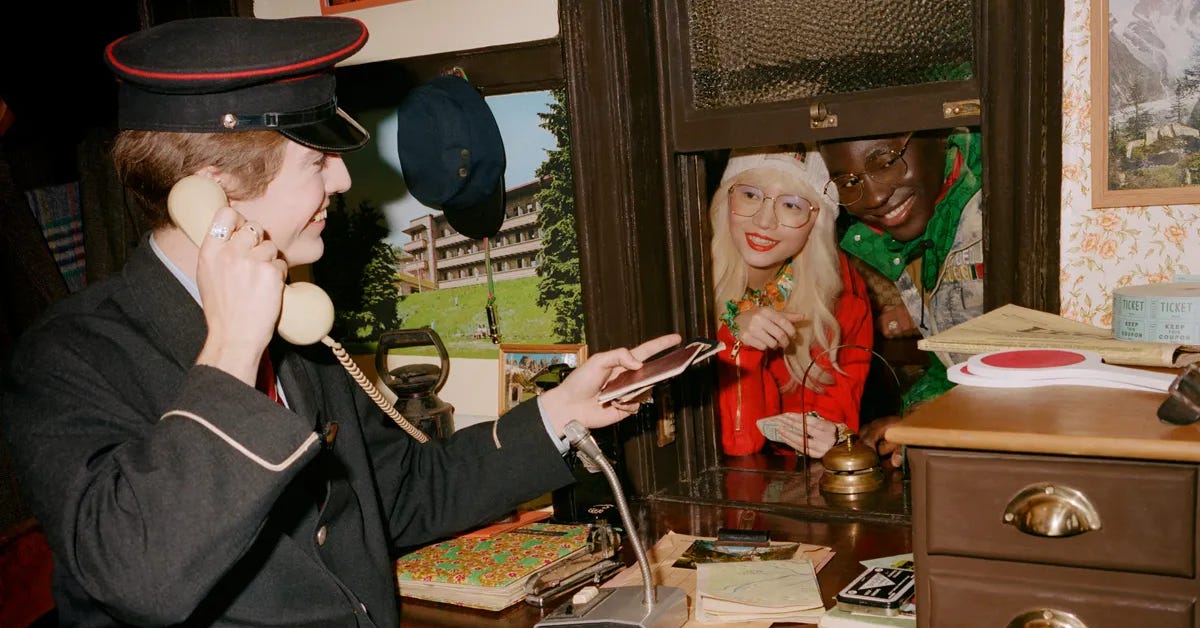
This is partly why Gucci partnered with Francis Bourgeois in 2022. There was something magnetic about the purity of his train obsession - a completely unironic devotion that felt like an antidote to the cynical irony that dominates online culture. This was a perfect example of product-culture fit.
Other examples provide a warning. Nicheness comes with its own risks precisely because audience relationships are indexed so high on meaning - perhaps even more so for Creators than brands themselves.
The Kindle ad with Jack Edwards tanked whatever credibility this previously trusted BookToker had. Here we had someone who’d spent years building authority by preaching the opposite of what Amazon represents - supporting independent bookstores, championing physical books, cultivating literary taste beyond bestseller algorithms. The poor guy ended up wiping his entire social media presence.
So many brands still treat Creators like sock puppets: using their name, image, and likeness, while stuffing their endlessly focus grouped, reach-as-many-as-possible-while-offending-the-least tone of voice down their throat.
To this I often have to say to them: what the fuck do you think you’re paying for? Do you, corporate marketing manager with 15 years of back-to-back FMCG experience, have intimate knowledge of the mushroom foraging community you’re so desperately trying to sell into?
You are paying for SPECIFICITY. Let the Creator be specific.
What Brands Can Actually Do
If you’re building for this shift, the question is how to enable obsession without destroying it.
Your brand needs to learn to act like an editor. Bring together niche creators and pay them to make things without forcing your logo into every frame. Let your brand become the canvas - where the brand associations are built as an aggregate mosaic of who you choose to associate yourself with.
The opportunity is more than content, it’s in the cultural capital that transfers to your brand when you’re seen as someone who funds things that don’t need to exist but should exist anyway.
This is the Red Bull model: fund extreme athletes, underground music scenes, niche sports that would never get mainstream sponsorship, then absorb the cultural credibility as ownable brand associations with energy, passion, and of course, risk.
This demands patience and a willingness to fund work without obvious KPIs, an enduring challenge in brand where, arguably, we are one of the only disciplines in the business that has to think beyond quarterly shareholder meetings. But the alternative is contributing to the everything-everywhere-sameness that’s already drowning your category.
Remember that half of the job of brand is being remembered, and the other half is being remembered for the right thing. So perhaps, try doing something memorable?
Not being everything, everywhere, all at once is actually human. That’s the real contradiction we’re living in: trying to embrace the infinite everything the algorithm throws at us while inhabiting a finite body and a finite life, with a beginning and an end.
Plato was right: we think we know things perfectly until we wake up and realise we know nothing. But at least now we know a lot about very little. And in a world of shallow puddles, that might be enough.
Read the next part of the series:

Great morning read. I run a niche natural wine brand, and this felt like a timely confidence boost.
That said, building ultra-niche from the inside is not romantic, it’s endurance. You deliberately narrow your market, grow slower, and carry conviction long before the numbers validate it. In the young wine scene especially, where anti-alcohol sentiment is reshaping consumption, the margin for error feels razor thin.
I’ve caught myself wondering how long you can push deeper into niche before you have to widen again, not out of strategy, but survival. At what point does focus become fragility..
Would love your take on that tension.
the thing that stayed in my mind the last few weeks is a friend of mine who at a dinner table said that his life goal is to save the rivers. I was like what a weird thing to say, and how beautiful at the same time. Weird interests paired with ambition goals, simply makes me listen to someone all day long.